Thursday, November 18, 2010
Sex scene from Ghost
Was just thinking how strange it was that Patrick Swayze is actually dead now, so presumably whenever anyone sits down at a potter's wheel they are in danger of severe molestation.
I think one of the good things about porn is that women have stopped expecting all that fiddly pre-sex messing about that was actually invented by Hollywood as a replacement for sex.
As you may be able to tell, I'm trying to break my blogging drought by just posting whatever I happen to be thinking. I had this really solemn post lined up about Borges and inevitability and the beefcake with a brain Dan Snow, but there was just no way of making it funny.

Wednesday, November 17, 2010
10 questions the client never asked
 |
| In a perfect world, all adverts would look like this one, from the back page of today's Guardian. |
2. Where is the URL?
3. Yeah but, how will they know how to get to iTunes?
4. Could they be holding iPods?
5. I can't see that one's face, can we shoot again?
6. Won't people think they work for Apple or something?
7. Where is the price?
8. Research says people don't like Ringo, can we take him out?
9. Where are the brand colours?
10. Can we make the logo bigger?
The perfect ad by the perfect agency working for the perfect client on the perfect product.
Jamie Oliver's new restaurant

Probably the only good thing about it is the view of St. Paul's and he can't really take credit for that. I wonder if he's even been there, or if he just let Adam Perry Lang license his name.
Tuesday, November 02, 2010
Yeah look sorry
Haven't posted in a while, this job is keeping me very busy indeed, and got a commission for the YCN annual which used up the spare room in my brain all last week (there is a spare room, and a cellar with a drain in the floor). Quite pleased with how it turned out.
Plenty to like about this. Tim Key is brilliant, although never all that funny on Charlie Brooker's show, he has a great comic sensibility if you knowhaddImean.
Fosters is a strange fit isn't it? But in way it's a better model where brands pay for high quality viral films and save on media than writing their own adverts.
I have a post, as it were, in the clip. I will fire right into your brain as soon as I get 20 minutes to type continuously without someone inviting me to a meeting.
Plenty to like about this. Tim Key is brilliant, although never all that funny on Charlie Brooker's show, he has a great comic sensibility if you knowhaddImean.
Fosters is a strange fit isn't it? But in way it's a better model where brands pay for high quality viral films and save on media than writing their own adverts.
I have a post, as it were, in the clip. I will fire right into your brain as soon as I get 20 minutes to type continuously without someone inviting me to a meeting.
Thursday, October 21, 2010
DDB VS VW WTF?
So when I was a kid DDB London used to make these incredible adverts for VW, whose wit and humour made me think that advertising might be an industry where intelligent people used creativity to communicate complex ideas as simply as possible.
 These days DDB London make ads like this for VW.

Which makes me think advertising is an industry where about a hundred deeply uncreative people sit in an airless meeting room insisting that they know what should be in their ad (which after all, they're paying for right?), overwhelm the account handlers with a combination of weight of numbers and sheer obdurate bloody-mindedness so that Jeremy Craigen has to wave through a lame headline ad with a look of mingled regret and resignation that seems to speak volumes about the state of our industry as a whole, but might just as well be his hangover.
These cuts are fun aren't they? I think we'll see riots on the streets of Glasgow and Leeds and everywhere else where the electorate has been in the pay of the government for the last 13 years, as soon as they realise they're not going to be able to afford the new iPhone for Christmas.


Which makes me think advertising is an industry where about a hundred deeply uncreative people sit in an airless meeting room insisting that they know what should be in their ad (which after all, they're paying for right?), overwhelm the account handlers with a combination of weight of numbers and sheer obdurate bloody-mindedness so that Jeremy Craigen has to wave through a lame headline ad with a look of mingled regret and resignation that seems to speak volumes about the state of our industry as a whole, but might just as well be his hangover.
These cuts are fun aren't they? I think we'll see riots on the streets of Glasgow and Leeds and everywhere else where the electorate has been in the pay of the government for the last 13 years, as soon as they realise they're not going to be able to afford the new iPhone for Christmas.
Monday, October 18, 2010
Friday, October 15, 2010
Could this be the worst ad ever made?
Exquisitely bad. And the bloke is called Tim - which, if you've ever met the Creative Director who made it, is tragic.
It's not just about how you sell stuff - it's also about how you treat people once you've sold them stuff
Great headline right?
I do this for a living.
How you treat people once you've sold them something is important, and this is a corollary of what Bill Bernbach said about truth and advertising: 'if you advertise a shit product well, all that happens is more people find out that it's a shit product.'
A salient comparison might be a relationship with, say, a woman.
If you spend years taking her out for dinner, writing her letters and sending her presents, she may well be somewhat disappointed by the farting, belching, videogame playing, priapic and emotionally needy genuine article. And watching her growing disenchantment with a combination of powerlessness and detachment may turn out to be a character-defining experience, part metaphor, part psychodrama, which you will return to, particularly if you've got an astonishingly precise memory for painful experiences, for at least, say, 9 months after you break up. For instance.
Anyway, the bastards have a word for how you treat people once you've sold them something - they call it CRM, or Customer Relationship Management. If you say that out loud you sound like a complete BMW driver, so I prefer to call it 'how you treat people'.
How you treat people is often an overlooked area of advertising, because it falls into the unglamorous neighbourhood of DM. A lot of brands seem to think that the best way to treat their customers is to hassle them into buying more stuff, or giving them worthless things to prevent them from leaving. This is a major problem for phone companies. They can't just relax and give you a good service, because their competitors are all offering you baubles to try to make you leave. Hence the endless sweaty phonecalls, mailshots and email updates about how wonderful the service they're giving you is.
On the other hand, a lot of the best, most exciting advertising of the last several years also falls into this category - things like Nike+ or iTunes. These things make you feel good about the decision you've already made. It's an easy win.
Very few agencies actually bother with this - they're only interested in picking people up, not with keeping them. They are all R Kelly and no Clare Rayner.
One of the reasons I'd rather be a copywriter than a journalist is that it's more truthful. And I'm not just saying that.
Where as whatever we write is necessarily attached to a real experience, the consumer's experience of the product, what journalists write is also their product. That means they have to either choose stories on the basis of their inherent appeal, or retool the truth in order to render it appealing. Either technique distorts reality, and not in the same way that adverts distort reality - because we never get to experience the news - it's offered instead of what happened. Adverts are offered as well as the product, really for as long as you continue to own or use that particular product.
What would happen if we all wrote ads designed to flatter existing customers? Wouldn't they then do most of the advertising for us? And wouldn't they be so much better at it than we are?
I do this for a living.
How you treat people once you've sold them something is important, and this is a corollary of what Bill Bernbach said about truth and advertising: 'if you advertise a shit product well, all that happens is more people find out that it's a shit product.'
 |
| Boho lifestyle brand Pedlars want to be perceived as fun and friendly. So when I bought an over-priced lightbulb from them they sent me this rosette to wear. It says 'I'm a Pedlars Customer'. The hateful cunts. |
If you spend years taking her out for dinner, writing her letters and sending her presents, she may well be somewhat disappointed by the farting, belching, videogame playing, priapic and emotionally needy genuine article. And watching her growing disenchantment with a combination of powerlessness and detachment may turn out to be a character-defining experience, part metaphor, part psychodrama, which you will return to, particularly if you've got an astonishingly precise memory for painful experiences, for at least, say, 9 months after you break up. For instance.
Anyway, the bastards have a word for how you treat people once you've sold them something - they call it CRM, or Customer Relationship Management. If you say that out loud you sound like a complete BMW driver, so I prefer to call it 'how you treat people'.
How you treat people is often an overlooked area of advertising, because it falls into the unglamorous neighbourhood of DM. A lot of brands seem to think that the best way to treat their customers is to hassle them into buying more stuff, or giving them worthless things to prevent them from leaving. This is a major problem for phone companies. They can't just relax and give you a good service, because their competitors are all offering you baubles to try to make you leave. Hence the endless sweaty phonecalls, mailshots and email updates about how wonderful the service they're giving you is.
On the other hand, a lot of the best, most exciting advertising of the last several years also falls into this category - things like Nike+ or iTunes. These things make you feel good about the decision you've already made. It's an easy win.
Very few agencies actually bother with this - they're only interested in picking people up, not with keeping them. They are all R Kelly and no Clare Rayner.
 |
| Of course, the best people to do this aren't the agency at all. I got this email from the British Boot Company when I asked my for brothel-creepers to be delivered to my home address. |
Where as whatever we write is necessarily attached to a real experience, the consumer's experience of the product, what journalists write is also their product. That means they have to either choose stories on the basis of their inherent appeal, or retool the truth in order to render it appealing. Either technique distorts reality, and not in the same way that adverts distort reality - because we never get to experience the news - it's offered instead of what happened. Adverts are offered as well as the product, really for as long as you continue to own or use that particular product.
What would happen if we all wrote ads designed to flatter existing customers? Wouldn't they then do most of the advertising for us? And wouldn't they be so much better at it than we are?
Thursday, October 07, 2010
Better than his Independent ad
I have this on a great Martin 'zero' Hannet comp. that makes taking heroin seem like it might be a good idea after all. Only £3.00 on Amazon.
Sorry about the Bumholes post this morning, but didn't you love the way the text was tiny so you had to lean really close to the screen to read it? Nice bit of art direction that.
Saturday, October 02, 2010

Tuesday, September 28, 2010
Brother Stevie: dirty 30
Perennial illustrator for this blog, and artistical genius Brother Stevie makes it to the big three-oh today. I suggest you go and have a look at his new Tumblr blog and commission him to do a series of family portraits, particularly if you're a billionaire oligarch werewolf. (Readership is up amongst billionaire oligarch werewolves, sitemeter says so ok?)

Happy Birthday Brother.
Happy Birthday Brother.
Monday, September 27, 2010
Show your working
I had an English teacher who used to say fascinating things to us. One of them was:
All novels are about writing novels.
What I think he may have meant was that writing a book is such a long, absorbing job that whatever else you set out to write about you end up writing about the process itself. The good thing is that the process of writing a book, which necessitates continual application, introspection, creativity alloyed with just the right amount of self-criticism, is something like a metaphor for life. So if novelists know anything at all about life, it's because they've spent all this time trying to do a very hard thing, for an imaginary reward that they either can't hope to achieve or, if they can, can't enjoy, and maybe learned something in the process.
Process though, is often interesting, often makes a good story.
(Nice turn from Andy Serkis there).
And if you think about the great American TV of recent years it's often as much about process, as result. The innovation of The Sopranos was to show the mafia boss in his dressing gown eating Parma ham straight from the fridge - it's just the Godfather, but with less left out. Shows like 30 Rock, The Wire and Madmen all work on a similar principle - they are all making-of dramas concerned with TV comedy, the drug trade and advertising respectively. That's why when you watch a DVD box set (and couples my age who are sick talking to one another don't do anything else) and reach the end of it, the feeling is not one of satisfaction, but disappointment. People still watch things with their teleological heads on, but they've stopped being interested in the ends of things. It's the process they want to see.
The modern experience of working as a tiny part of a much larger system, and being made aware of that system by the media, means that the goals that we work towards are likely to feel less dramatic. Especially in the context of global news and the knowledge that everyone is up to more or less the same thing. Ends don't feel special or significant any more.
This is just one of the reasons that video games are a better entertainment fit for modern life. They are designed to prevent you from getting to the end. Like the impossibly apostrophised Demon's Souls, which, well, you may as well write a novel as try and finish that game.
In other news, I saw Mick Jones on Friday night outside Hix on Brewer Street. Long term readers will know that Mick Jones tends to pop up at crucial moments in my life, looking terrible. I somehow didn't have my wits about me enough to take his picture, but I did say hello. I then spent the rest of the evening regretting not having photographed Mick Jones on my mobile so I could post it on my blog. A modern neurosis if ever there was one.
All novels are about writing novels.
What I think he may have meant was that writing a book is such a long, absorbing job that whatever else you set out to write about you end up writing about the process itself. The good thing is that the process of writing a book, which necessitates continual application, introspection, creativity alloyed with just the right amount of self-criticism, is something like a metaphor for life. So if novelists know anything at all about life, it's because they've spent all this time trying to do a very hard thing, for an imaginary reward that they either can't hope to achieve or, if they can, can't enjoy, and maybe learned something in the process.
Process though, is often interesting, often makes a good story.
(Nice turn from Andy Serkis there).
And if you think about the great American TV of recent years it's often as much about process, as result. The innovation of The Sopranos was to show the mafia boss in his dressing gown eating Parma ham straight from the fridge - it's just the Godfather, but with less left out. Shows like 30 Rock, The Wire and Madmen all work on a similar principle - they are all making-of dramas concerned with TV comedy, the drug trade and advertising respectively. That's why when you watch a DVD box set (and couples my age who are sick talking to one another don't do anything else) and reach the end of it, the feeling is not one of satisfaction, but disappointment. People still watch things with their teleological heads on, but they've stopped being interested in the ends of things. It's the process they want to see.
The modern experience of working as a tiny part of a much larger system, and being made aware of that system by the media, means that the goals that we work towards are likely to feel less dramatic. Especially in the context of global news and the knowledge that everyone is up to more or less the same thing. Ends don't feel special or significant any more.
This is just one of the reasons that video games are a better entertainment fit for modern life. They are designed to prevent you from getting to the end. Like the impossibly apostrophised Demon's Souls, which, well, you may as well write a novel as try and finish that game.
In other news, I saw Mick Jones on Friday night outside Hix on Brewer Street. Long term readers will know that Mick Jones tends to pop up at crucial moments in my life, looking terrible. I somehow didn't have my wits about me enough to take his picture, but I did say hello. I then spent the rest of the evening regretting not having photographed Mick Jones on my mobile so I could post it on my blog. A modern neurosis if ever there was one.
Friday, September 24, 2010
Friday, September 17, 2010
Judging book covers
I had imagined taking a couple of weeks off after the end of my MA and just reading and blogging and playing video games but it doesn't seem to have worked out quite like that. This is one of about eight posts that I've been planning but somehow haven't got round to writing. I might dribble them out over the next few weeks because I anticipate that I'm going to be rather busy
(BECAUSE SOMEONE HAS GIVEN ME A JOB RIGHT?!).
So I wrote this very long essay about Kingsley Amis for my MA, and one of the the byproducts of it was that I ended up doing a sort of impromptu study of the covers of Amis's novels. I got all the criticism up from the stack of the British Library but I'd buy random editions of the novels from second hand shops for £2 each so I could dog-ear the pages and come back and note them later. Most secondhand and charity bookshops have a whole Amis section, with Martin featuring as much, if not more than, his father. Make of that what you will.
Book covers are very like what we do. Whenever we make an advert we are asking the consumer to ignore the old axiom and judge a book by its cover. In fact an ad bears even less relation to a product than a book does to its cover because it doesn't even have the benefit of physical proximity to the object it describes. An ad makes up for it though, because it can contain pictures of what it's describing, where as a cover although attached to the book actually describes something much less concrete - the contents of the book, rather than the object of which it is also a part.
(I START NEXT MONDAY!!).
KA had a very long writing career, spanning around four decades, and his reputation evolved as he went on, from Angry Young Man, to sexy young author, to establishment figure, to reactionary outsider. But, for complex reasons (which, if you're interested, I can send you a 15,000 word essay about), Amis's subject matter changed very little. So what we have is a fairly consistent product that is differently perceived by each successive era.
Something like a very well known brand that has a series of different agencies work on it.
Obviously there are a few obvious reactions to the brief. Since they're largely concerned with the relationships between men and women, really, almost all Amis covers could be like this:


'Yeah so hi Peter Blake, love the cover and everything, but is there any chance we could have the title just a bit bigger? Because at the moment it looks like the title of this million selling book that everyone knows the name of, and is on reading lists all over the world, is England's Glory - which, yes, would be a great title for a book obviously - but isn't actually ... yes I have heard of the Sergeant Pepper's album ...'
I reckon the good ones will age best. I wrote a thing for the Tattooed Lady Magazine recently about the History of Advertising Trust and how adverts are totally contemporary and therefore totally disposable - but isn't it almost always true that the best ones aren't? And therefore doesn't it follow that the that best ones are tied to the truth rather than to the time.
I've got another post about book covers - but I think I'll save it...
(BRING ON MONDAY, I'M A TIGER, A TIGER, RRRRRRRRRAAAAAAAAAAARRRRRRRGH!)
(BECAUSE SOMEONE HAS GIVEN ME A JOB RIGHT?!).
So I wrote this very long essay about Kingsley Amis for my MA, and one of the the byproducts of it was that I ended up doing a sort of impromptu study of the covers of Amis's novels. I got all the criticism up from the stack of the British Library but I'd buy random editions of the novels from second hand shops for £2 each so I could dog-ear the pages and come back and note them later. Most secondhand and charity bookshops have a whole Amis section, with Martin featuring as much, if not more than, his father. Make of that what you will.
Book covers are very like what we do. Whenever we make an advert we are asking the consumer to ignore the old axiom and judge a book by its cover. In fact an ad bears even less relation to a product than a book does to its cover because it doesn't even have the benefit of physical proximity to the object it describes. An ad makes up for it though, because it can contain pictures of what it's describing, where as a cover although attached to the book actually describes something much less concrete - the contents of the book, rather than the object of which it is also a part.
(I START NEXT MONDAY!!).
KA had a very long writing career, spanning around four decades, and his reputation evolved as he went on, from Angry Young Man, to sexy young author, to establishment figure, to reactionary outsider. But, for complex reasons (which, if you're interested, I can send you a 15,000 word essay about), Amis's subject matter changed very little. So what we have is a fairly consistent product that is differently perceived by each successive era.
Something like a very well known brand that has a series of different agencies work on it.
Obviously there are a few obvious reactions to the brief. Since they're largely concerned with the relationships between men and women, really, almost all Amis covers could be like this:

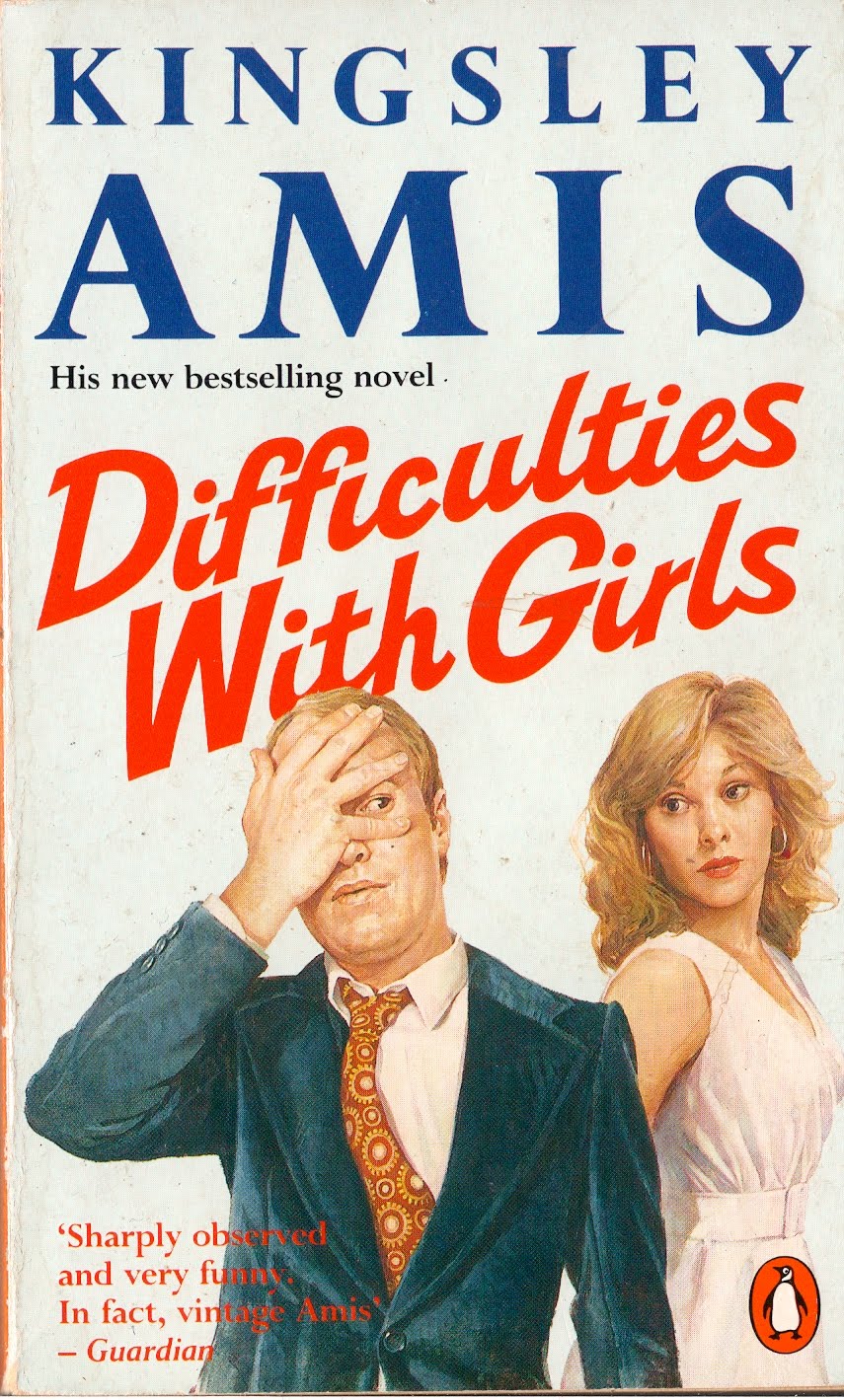
Personally I don't like these covers much because I don't want to be told what Patrick Standish or Jenny Bunn look like - I think that's something I do on my own with Kingsley Amis, and I don't appreciate having to share that experience with a illustrator who's probably only skim-read the novel. Both of these are rather craven portrayals of the character, Stanley with a little moustache, Patrick blonde and balding at the temples. They don't tell me what's interesting about these books, what makes them different, in fact all they tell me is what's inside the book, which is redundant, given that it's inside the book. The Difficulties cover is a 1989 number, the Stanley cover is the Vintage 2008 reissue. Difficulties is set in the 60s and Stanley in the 80s, but you wouldn't know it would you? The primary fidelity of these covers is to the aesthetic sensibilities of the time in which they were produced.

This cover on the left is just straightforwardly misleading. This edition is from, who would have thought it, 1970. Amis writes about sex but never describes it, never really describes bodies, male or female, but does occasionally mention breasts. There is sex in this book, but perhaps not as much or of the kind that you might hope for had you only seen the cover. The problem is that the cover art is based on a perception of what the audience wants - the art director lost track of the truth of the novel in the pursuit of his audience.
(BETTER MAKE SURE I DON'T DO THAT...IN MY NEW JOB!!!!)
(BETTER MAKE SURE I DON'T DO THAT...IN MY NEW JOB!!!!)
The best covers are not those that try to represent the characters, but those that represent the themes:


The Old Devils and Jake's Thing are concerned with the end of a life spent drinking and an Oxford don's struggle with impotence respectively. Both of these are visual gags of a very high order indeed - not only is that good in itself, but their comedy, in turn, describes the humour and intelligence of the books. By hanging on to the essence of the books they avoid the pitfalls of pandering to the audience. They also avoid merely repeating information that is already in the books (by showing characters and situations etc.) and instead offer something that's more like a new interpretation of the same central idea. This, I believe, is what bastards mean by 'adding value'.
But obviously this too can go too far, the cover that really makes me laugh is the new Penguin 50s 2010 edition of Lucky Jim. Imagine being the client on this one:

'Yeah so hi Peter Blake, love the cover and everything, but is there any chance we could have the title just a bit bigger? Because at the moment it looks like the title of this million selling book that everyone knows the name of, and is on reading lists all over the world, is England's Glory - which, yes, would be a great title for a book obviously - but isn't actually ... yes I have heard of the Sergeant Pepper's album ...'
I reckon the good ones will age best. I wrote a thing for the Tattooed Lady Magazine recently about the History of Advertising Trust and how adverts are totally contemporary and therefore totally disposable - but isn't it almost always true that the best ones aren't? And therefore doesn't it follow that the that best ones are tied to the truth rather than to the time.
I've got another post about book covers - but I think I'll save it...
(BRING ON MONDAY, I'M A TIGER, A TIGER, RRRRRRRRRAAAAAAAAAAARRRRRRRGH!)
Friday, September 10, 2010
Wednesday, September 08, 2010
You don't need a 30 year old blogger to tell you how good this is
Creepy song, with a wonderful chorus.
Tuesday, September 07, 2010
It's a horrifying terrifying event
Just got home from being sworn at by Doug Stanhope at the Leicester Square Theatre - he's on for another four nights and there seemed to be some returns on the door. You need to go and see him because there's a chance he may commit suicide on stage, which I've never heard of anyone doing before, but if anyone were going to, it would be him.
I mean, anyone apart from Jesus.
PS: I'm in the process of tinkering with the design of the blog - you may also notice some Google Adwords giving you links here. Willful perversity is the only explanation I can offer you.
Monday, September 06, 2010
The Renaissance Renaissance
Happened to be watching the Box the other day and saw this video.
And what it made me think was that music videos have entered this new phase where they're no longer trying to ring the cherries of the lowest common denominator. They're actually starting to look more and more like serious, ironic, or genuinely beautiful art. And this has happened very quickly indeed, compare and contrast this Hype Williams 1999 classic:
The message of the Big Pimpin' video is roughly, 'we're so rich we've got a huge white boat and crates of Dom Peringnon and whole squadrons of women who don't find being sprayed with champagne demeaning, in fact they rather like it actually.' The message of the Kayne West videos is, approximately, 'I'm so rich I can pay real artists to make my videos'.
This is what brands are doing when they employ skilled advertisers - the whole selling shit schtick is just a ruse to justify it to the accounts department. Really it's the geeks getting to tell the art kids what to do.
But then the hugely rich have traditionally been prepared to pay for art, designed for the masses, as a demonstration of their power. Because talent the one thing they can't buy and it makes them furious. Like the Medicis all over again.
Which is not to take anything away from Kayne, if he's reading this, which I'm sure he is.
And what it made me think was that music videos have entered this new phase where they're no longer trying to ring the cherries of the lowest common denominator. They're actually starting to look more and more like serious, ironic, or genuinely beautiful art. And this has happened very quickly indeed, compare and contrast this Hype Williams 1999 classic:
The message of the Big Pimpin' video is roughly, 'we're so rich we've got a huge white boat and crates of Dom Peringnon and whole squadrons of women who don't find being sprayed with champagne demeaning, in fact they rather like it actually.' The message of the Kayne West videos is, approximately, 'I'm so rich I can pay real artists to make my videos'.
This is what brands are doing when they employ skilled advertisers - the whole selling shit schtick is just a ruse to justify it to the accounts department. Really it's the geeks getting to tell the art kids what to do.
But then the hugely rich have traditionally been prepared to pay for art, designed for the masses, as a demonstration of their power. Because talent the one thing they can't buy and it makes them furious. Like the Medicis all over again.
Which is not to take anything away from Kayne, if he's reading this, which I'm sure he is.
Subscribe to:
Posts (Atom)